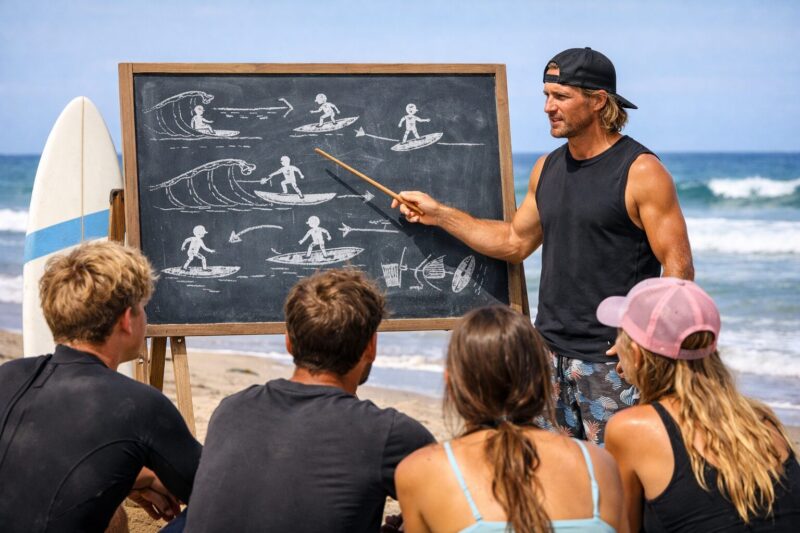
Surfing has rules. Nobody posts them on the beach, and nobody explains them when you paddle out. You are just expected to know.
In Okinawa they matter more than in most places. The waves break over reef, so everyone sits at the same small take-off spot. The lineups are small, and you will see the same faces every week. And there are a few local customs, such as Obon, that you will not find in any surf guide written overseas.
I live in Okinawa and surf here all year. I have broken some of these rules by accident, and I have been yelled at for it. This guide is everything I would tell a friend before their first session here.
This page contains affiliate links. Buying through them supports this blog at no extra cost to you.
The Short Version
- One wave, one surfer. The surfer closest to the peak goes.
- Look toward the peak before you paddle for any wave.
- Take turns. Do not sit deepest and take every set.
- Say hello when you paddle out, and say sorry when you get it wrong.
- Park properly, keep quiet, take your trash home. Most spots are next to people’s homes.
- Stay out of the water during Obon, the three days in late summer when many locals do.
Why the Rules Matter More on a Reef
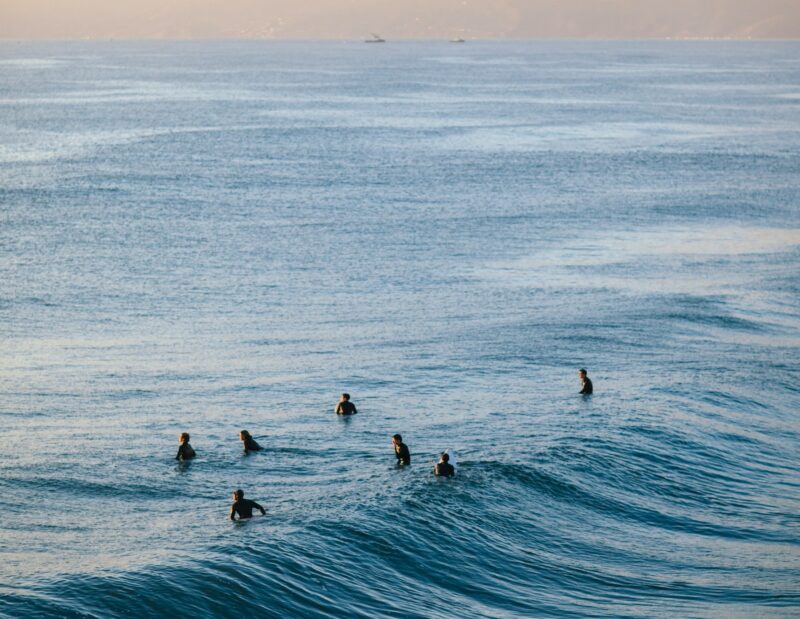
On a beach break, the waves shift around and people spread out. On a reef, the wave breaks in the same place every time. That creates one take-off spot, and everybody wants it.
- The crowd is concentrated. Ten surfers on a reef can feel like forty on a beach.
- Mistakes hurt more. The water is shallow and the bottom is sharp. A collision that would be a laugh over sand can mean stitches here.
- People remember you. The same regulars surf the same spots for years. If you live here, you are building a reputation from your first session, good or bad.
The good news is the other side of that last point. Follow the rules, say hello, and within a few months you are one of the familiar faces.
The Rules in the Water
One wave, one surfer
This is the rule everything else comes from. One wave carries one surfer. The right to it goes to the person closest to the peak, which is the spot where the wave starts to break.
The habit that makes this work is simple. Before you paddle for a wave, look toward the peak. If someone there is paddling or already on their feet, the wave is theirs. Stop paddling.
There is one exception. When a wave breaks from the middle and peels both ways, two surfers can share it, one going left and one going right.
Do not drop in
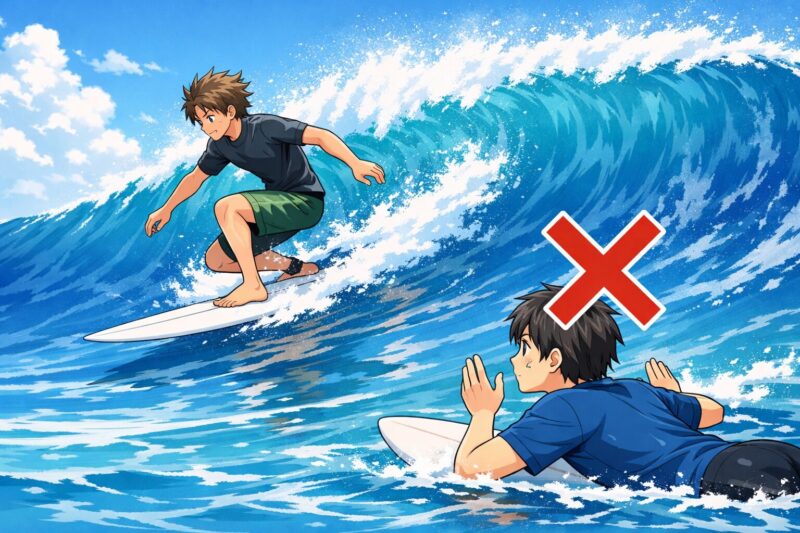
Dropping in means taking off in front of a surfer who already has the wave. It is the most common mistake in surfing and one of the most dangerous. The person riding is moving fast and has nowhere to go.
I have done it. I got a loud “Oi!” from the surfer behind me, and I deserved it. Since that day I check toward the peak every single time before I paddle.
If you drop in by accident:
- Get off the wave right away. Kick out over the back or straighten out toward the beach.
- Apologize. A clear “sumimasen” and a raised hand is enough.
- Do not do it twice. Once is a mistake. Twice is a habit, and people notice.
Do not snake
Snaking is paddling around someone who is already in position, so that you end up closer to the peak and take their wave. It can look legal from the beach. Everyone in the water knows what happened.
Dropping in is usually an accident. Snaking is a choice. It is the fastest way to lose the goodwill of a lineup.
Take turns at the peak
Because a reef has one take-off spot, the lineup works like a line at a store. You wait, you take your wave, you paddle back and you go to the end.
- Do not paddle straight back to the deepest spot after every ride.
- Do not take every set just because your board lets you. A big soft board catches waves early. That is an advantage, so use it politely.
- Let some go. Giving a wave away now and then is noticed, and it comes back to you.
Paddle out wide
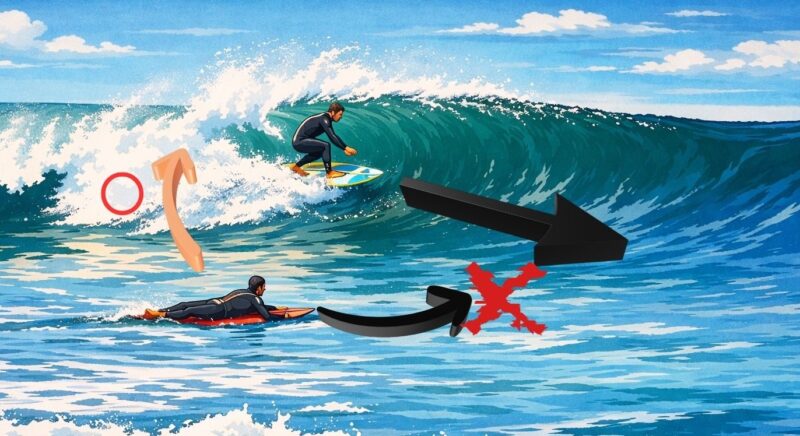
When you paddle back out, stay out of the way of anyone riding.
- Go around the break, through the deeper water at the side, even if it takes longer.
- If you are caught in front of a rider, paddle toward the whitewater, behind them. You will take a wave on the head. That is the price.
- Do not sit right behind another surfer, and do not wait on the inside where riders finish their waves.
Hold on to your board
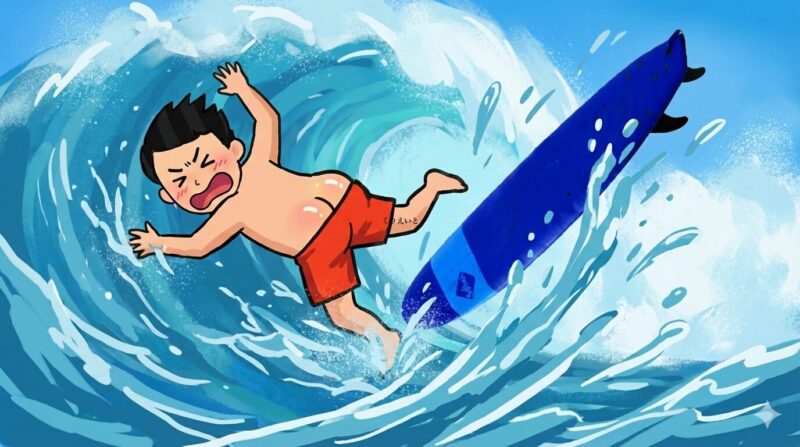
A loose board is a weapon. The nose is hard, the fins are sharp, and a wave gives it real force.
- Always wear a leash. It keeps your board from hitting the people behind you.
- Do not throw your board away when a wave comes. A leash can snap, and there is almost always someone behind you.

Beach Access premium light leash, 6 to 10 ft (Amazon Japan)

Surf waves that match your level
Paddling out in waves you cannot handle puts other people at risk as well as you. Someone has to avoid you, and someone may have to help you.
If you are not sure, ask at a local surf shop: “Is today OK for a beginner?” Nobody will think less of you for asking.
Locals: Who They Are and How to Get Along
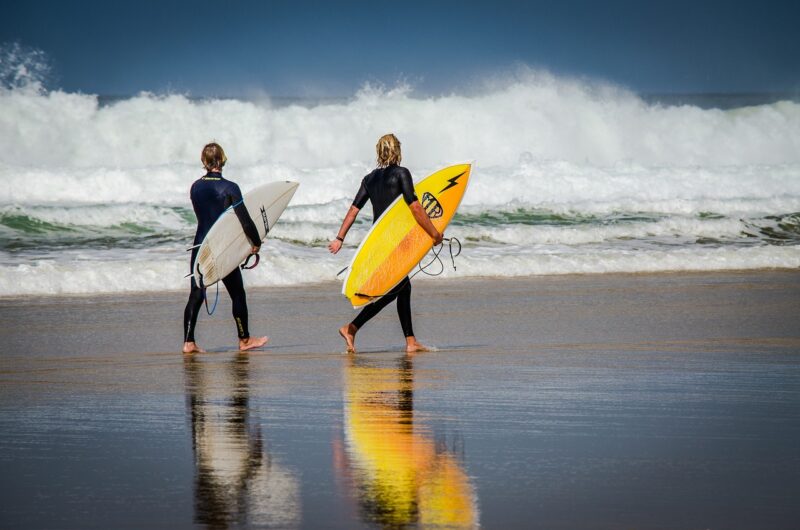
Every spot in Okinawa has its regulars. In my experience, if you follow the basic rules, you will have no problems with them.
A local is not only someone who was born next to the beach. It can be someone who has surfed the same spot for years, or someone who started surfing with that crew. Nobody hands out the title. Other people start calling you one.
It also helps to see it from their side. At smaller spots, the regulars are often the people who cut the grass on the path and keep the parking area usable. Then a stranger arrives and paddles straight to the peak. You would be annoyed too.
Say hello
A greeting changes everything. People who look intimidating in the lineup nearly always turn out to be friendly once you have said good morning.
I am not an outgoing person, and I still do it. You do not need a conversation. You need one word and a nod.
Do not arrive as a crowd
If you surf with friends, do not paddle out as a group of six to the same peak. The people already there watch their session disappear.
- Go out two or three at a time, a few minutes apart.
- Spread out along the reef if there is more than one peak.
About the spots I do not write about
Some spots on the island are surfed almost only by locals. I do not list them on this blog, and I suggest you do not post their locations online either.
The way into those places is through people. Here in Okinawa, I have shared a drink with surfers in the evening and been told, “Come surf with us tomorrow.” That is how it works. Be someone people are glad to see.
If someone is angry with you
Apologize, even if you are not sure what you did. Do not argue in the water. Move down the reef or go in, and think it over on the beach.
On Land: Parking, Noise and Trash
Good behavior in the water can be undone in the parking lot. Most surf spots here sit right next to homes, farms and fishing harbors.
- Park properly. Do not block driveways, farm roads or harbor access, even for a quick check of the waves.
- Keep the noise down, especially at dawn. Car doors, music and loud voices carry a long way at six in the morning.
- Take your trash home. Public trash cans are rare in Japan. If you pick up one extra piece on your way out, even better.
- Change discreetly. There are no changing rooms at most spots. Use a poncho or a large towel.
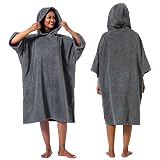
Winthome microfiber changing poncho (Amazon Japan)
A note about Komesu Coast
The spot surfers call Suicide Cliffs is on Komesu Coast in Itoman. This stretch of coast saw some of the last fighting of the Battle of Okinawa in 1945. The Konpaku Memorial in Komesu was built in 1946, and for many years it held the remains of about 35,000 people who died in the battle. Families still come to pray.
So keep it respectful around the parking areas there. No loud music, and do not joke about the nickname.
Obon: Three Days to Stay Out of the Water
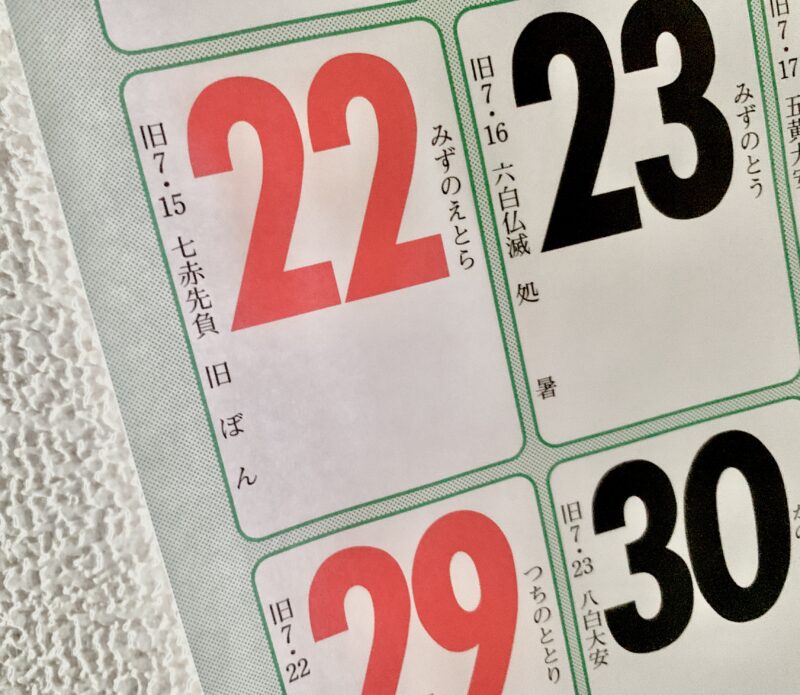
Obon is the time of year when the spirits of ancestors are believed to return home for a visit. In Okinawa it follows the old lunar calendar, on the 13th, 14th and 15th days of the seventh lunar month. The dates move every year.
The three days have names. The first is Unke, when families welcome their ancestors. The middle day is Nakabi. The last is Ukui, when the ancestors are sent back.
Why locals stay out of the sea
Most people who grew up here were told the same thing as children: do not go near the ocean during Obon.
The belief is that the sea is where this world meets the next. Along with the ancestors, spirits with no family to welcome them are also said to return and wander. Go in the water, especially on the last day, and they may pull you under by the legs and take you with them.
There are practical reasons behind the custom too.
- It is typhoon season. Large swells can arrive from distant storms even on a calm, sunny day.
- The tides are at their strongest. Obon ends on the 15th day of a lunar month, which is the full moon. That means spring tides and stronger currents.
- Jellyfish are around in numbers at that time of year.
I tried it once
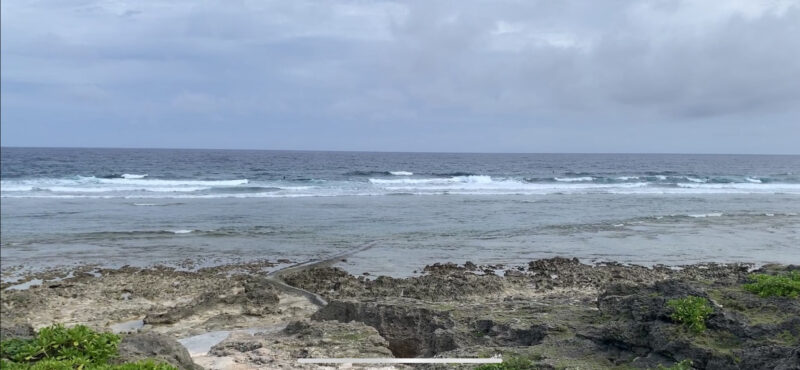
On August 21, 2021, the middle day of Obon, I surfed at Komesu Coast. I picked the middle day on purpose. The last day is said to be the most dangerous, and I did not want to push my luck.
A typhoon happened to be approaching Okinawa that day. There were about 20 surfers out, which is few for a Saturday. The wind was strong and onshore. The waves were chest high, with much bigger sets that came out of nowhere.
I barely caught a wave, and I was scared. The current was fast. Whenever I stopped paying attention, I had drifted a long way. I was out of the water in under an hour.
My conclusion: stay home during Obon. If my parents read this, I am in trouble.
What I suggest
Nobody will stop you from surfing during Obon. It is a custom, not a law, and you will see a few people in the water.
But staying out for three days costs you very little, and it is an easy way to show respect for the place you are living in. Go and watch Eisa instead. During Obon, drum and dance groups parade through many neighborhoods in the evenings.
Summary
Surfers watch each other more than you think. People who break the rules and do not apologize get a reputation fast. People who follow them and say hello become someone the lineup is glad to see.
For what can hurt you in the water here, read Okinawa Surf Hazards. If you are just getting started, read How to Start Surfing in Okinawa. For spots, tides and seasons, see Surfing in Okinawa: A Local’s Guide.
See you in the water.

コメント